
Most cucumber plants produce two completely different types of flower on the same plant. One of them will become a cucumber. The other one will not. And in certain circumstances, if these two flowers meet at the wrong time, the resulting cucumber can actually make you ill.
I'm not exaggerating for dramatic effect, by the way. Stick with me and I'll explain exactly why, because once you know what's actually happening at the molecular level, you'll understand why every cucumber grower needs to be able to tell a male flower from a female flower at a glance.
The good news is that telling them apart is easier than telling a robin from a sparrow. The slightly trickier news is that there are actually three different categories of cucumber plants on sale today, each of which produces flowers in a different way, and the rules for managing male flowers depend entirely on which kind you've bought.
Let's start with the basics, then I'll get into the science.
Video
Prefer to watch a video? Don't worry, I have you covered!
Video
Prefer to watch a video? Dont worry, I have you covered!
How to tell them apart
Look behind the flower.
That's it. That's the entire identification method. Crouch down, gently lift the flower with a fingertip, and look at the little bit between the flower and the vine.
If there's a tiny miniature cucumber tucked behind the petals, it's a female flower. The miniature cucumber is the ovary, and if everything goes to plan, it'll swell up and become the cucumber you eventually eat.
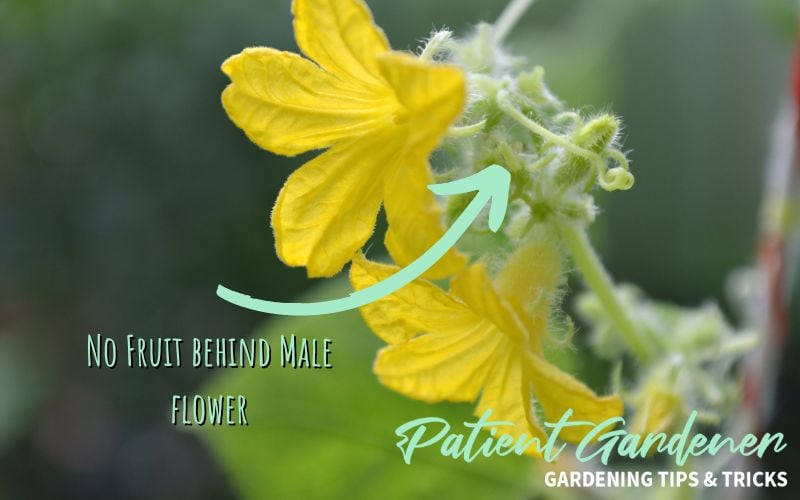
If there's nothing behind the flower except a slim stalk, it's a male flower. Its only job is to produce pollen.
Female Cucumber Flower
Here you can see a female cucumber flower. Look at the tiny little cucumber behind the yellow petals. That's the ovary. The female flower sits on its own, one to a leaf node, and is generally a little larger and more substantial-looking than its male counterparts.

Male Cucumber Flower
And here's a male flower. No baby cucumber behind it. Just a slender green stalk attaching the flower to the vine. Male flowers also tend to appear in clusters of two, three, or four together, rather than the solitary female. Once you've seen the difference once, you'll never confuse them again.
So far, so straightforward. But here's where it gets interesting, because the proportion of male to female flowers on your plant depends entirely on what kind of cucumber you bought, and that's where most home gardeners get caught out.
The three types of cucumber plant (and why this matters)
There are essentially three categories of cucumber plant you'll find for sale today, and they behave completely differently when it comes to flowering. Most plant labels do a terrible job of explaining this, which is why I want to spell it out properly.
1. Monoecious varieties (the old-fashioned ones)
These are the traditional, "heritage", or "outdoor" varieties. The word monoecious is pronounced mon-EE-shus and comes from the Greek for "single house", meaning both flower types share the same plant. Most ridge cucumbers, picking cucumbers, and traditional varieties like Marketmore, Boston Pickling, and Marketer are monoecious.
These plants produce male flowers first, often for a couple of weeks before any female flowers appear at all. This catches a lot of new growers out. You'll be staring at a plant covered in flowers for a fortnight thinking "where are my cucumbers?" The answer is that the plant is attracting pollinators with male flowers first, and only then starting to produce female flowers that need pollinating.
For monoecious varieties grown outdoors, you leave the male flowers alone. Pollinators (mainly bumblebees and honeybees) carry pollen from male to female flowers, the female flowers get fertilized, and the baby cucumbers behind them swell into full-sized fruit. The whole thing works as nature intended.
2. Gynoecious varieties (the modern all-female types)
Gynoecious (pronounced guy-NEE-shus, "female house") varieties have been bred to produce only female flowers, or at least to produce them in overwhelming majority. Every flower has a baby cucumber behind it. Every flower has the potential to become a fruit. The yields on these are astonishing compared to old monoecious types, which is why they've taken over greenhouse growing.
Many of the modern F1 hybrids you'll buy for greenhouse or polytunnel growing are gynoecious. Names like Carmen F1, Bella F1, Femspot, and Socrates F1 are all gynoecious.
The most important thing to know about these plants is the next category, because the two often work as a pair.
3. Parthenocarpic varieties (the magic ones)
Parthenocarpic (par-then-oh-CAR-pic) is the most interesting word in this entire article. It comes from the Greek parthenos meaning "virgin" and karpos meaning "fruit", so literally "virgin fruit". And that's exactly what these plants produce. Cucumbers without fertilisation.
In a parthenocarpic variety, the female flower doesn't need to be pollinated at all. The baby cucumber behind the flower just swells and develops into a full-sized, seedless, perfectly edible cucumber all on its own. No bees required. No pollen required. The fruit develops parthenocarpically, which is to say, via virgin birth.
This is genuinely brilliant for greenhouse and polytunnel growing, where pollinators don't always reach. It's also why supermarket cucumbers are seedless. Almost all commercial greenhouse cucumber production now uses parthenocarpic varieties. Mini cucumber varieties like Mini Munch, Mini Stars, and most of the "all-female greenhouse types" sold to home growers are both gynoecious AND parthenocarpic. They produce only female flowers, and those flowers develop into fruit without any pollination at all.
Now, here's the part that almost no plant label or seed packet explains, and it's the reason this whole article exists.
The bit that can actually make you ill
When you grow a parthenocarpic, gynoecious variety, you must not allow that plant's female flowers to be pollinated.
I'll say that again because it sounds counterintuitive. Parthenocarpic cucumbers do not want to be pollinated. If they are pollinated, the resulting cucumbers become bitter, deformed, full of hard seeds, and in some cases, genuinely unsafe to eat.
This is where most of the "my cucumbers are really bitter" complaints come from, and the answer involves some genuinely interesting chemistry.
What's actually happening: cucurbitacin
Cucumbers, along with their cousins courgettes, melons, squash, and pumpkins (all in the family Cucurbitaceae), produce a group of bitter compounds called cucurbitacins. These are the plant's natural defence against being eaten by insects and grazing animals. In wild cucumber ancestors, the entire plant was loaded with cucurbitacins. They taste so unpleasant that even deer leave them alone.
Over thousands of years of breeding, we've selected cucumber varieties that produce very low levels of cucurbitacin in the fruit, which is why modern cucumbers are pleasant to eat. But the genes that produce cucurbitacins are still there in every plant, and they can switch back on under certain conditions.
The conditions that switch them on include:
Pollination of a parthenocarpic variety. When a parthenocarpic cucumber receives pollen it wasn't bred to handle, it produces fruit with seeds it wasn't designed to nurture. The plant treats this as an internal stress response and elevates cucurbitacin levels in the resulting fruit. The cucumbers come out grossly bitter, often with a strange bulbous shape near the blossom end where the seeds have formed.
Plant stress. Heat stress, water stress (both over and under), nutrient deficiency, and root damage can all trigger increased cucurbitacin production across the whole plant, including in the fruit. This is why a cucumber from a struggling plant in August can taste fine at the stem end and bitter at the blossom end.
Genetic reversion. Very occasionally, a parthenocarpic plant under significant stress will revert to producing male flowers as part of a stress response. The plant essentially decides, "things are not going well, I should try the older reproductive strategy as a backup," and starts producing male flowers it shouldn't be producing. These male flowers can then pollinate the female flowers on the same plant, triggering both the bitter-cucumber response AND elevated cucurbitacin levels in the affected fruit.
This is the bit that catches people out. They've bought an all-female variety, planted it carefully in the greenhouse, and one day notice a few male flowers appearing. They assume the plant is "just doing its thing" and leave them alone. The male flowers pollinate the females. Two weeks later, the resulting cucumbers taste like burning chemicals. The grower has no idea why.
The classic beginner mistake - mixing varieties in the same greenhouse
This is the one I see most often, and it ruins more home-grown cucumbers than anything else.
You go to the garden centre in spring, and you buy two cucumber plants because two is better than one. One of them is a modern all-female greenhouse type. The other is a traditional outdoor variety, often picked up cheap or grabbed because the label said something appealing like "reliable" or "good for pickling". You take them home, plant them both in the greenhouse because you've got a bit of spare space, and water them in feeling pleased with yourself.
A few weeks later, the outdoor variety happily starts producing its male flowers. Bees wander in through the open door. They visit the male flowers, get coated in pollen, and then move over to the all-female plant a few feet away. They do exactly what bees are supposed to do.
The result is a greenhouse full of bitter, deformed, sometimes-toxic cucumbers on the plant that was never meant to be pollinated. The outdoor variety, ironically, will be fine. It's the modern "better" plant that suffers.
The rule is simple. Don't grow monoecious (heritage) and gynoecious-parthenocarpic (all-female greenhouse) varieties in the same enclosed space. If you only have one greenhouse, pick one type and stick to it. If you want to grow both, put the heritage variety outdoors and the all-female variety inside. Bees can still travel between them, so distance helps, but a wall and a roof between the two solves the problem almost entirely.
If you've already planted them together this year and you've just realised what's about to happen, you have two options: rip out the monoecious plant before its male flowers open (painful but works), or move the traditional cucumber outside and as far away from the greenhouse as possible.
This is the bit nobody tells you when they sell you the plants. Now you know.
Can cucumbers actually make you ill?
Yes. And this is not gardening folklore.
At low levels, cucurbitacin tastes bitter and unpleasant. You'd probably spit it out or refuse to eat any more. But if you persist (or worse, eat it in something where the bitterness is masked, like a baked dish, unlikely to happen with cucumbers but does happen with courgettes), cucurbitacin causes gastrointestinal distress. The symptoms include severe nausea, vomiting, stomach cramps, and diarrhoea. It's been formally documented in medical literature as "toxic squash syndrome" or "cucurbit poisoning", and while it's rarely life-threatening in modern adults, it has caused hospitalisations.
There was a notable case in Germany in 2015 where a man died after eating a bitter courgette his neighbour had given him, with cucurbitacin poisoning identified as the cause. Cases involving cucumbers are less severe but very much real, especially in children who can't identify what's wrong before they've eaten too much.
So when I say to bin any cucumber that tastes intensely bitter, I'm not being cautious. I'm telling you to actually throw it away, properly, and to bin any others from the same plant. Don't try to mask the flavour. Don't eat around the bitter end. Just compost the lot and move on. A pack of cucumber seeds costs a few pounds. A weekend in A&E with cucurbitacin poisoning is considerably worse.
The simple rules that prevent all of this
This sounds alarming, I realise. But preventing the problem is genuinely simple once you know which type of cucumber you're growing.
If you're growing a monoecious (heritage / outdoor) variety:
Leave the male flowers alone. Let the bees do their work. Both male and female flowers are normal and required. The plant relies on pollination to produce fruit, and cucurbitacin levels will stay low as long as the plant itself isn't badly stressed.
If you're growing a gynoecious + parthenocarpic (modern greenhouse / all-female) variety:
You should not see any male flowers at all. If you do see them, remove them immediately by pinching them off at the stem. This is the most important job you have as a greenhouse cucumber grower. Check the plants every few days during peak growth and snip off any male flowers before they open.
Additionally, you want to keep these plants away from monoecious varieties. If you have an outdoor cucumber producing male flowers, and a greenhouse cucumber producing female flowers, bees can carry pollen between them and contaminate the parthenocarpic plant. The general advice is to grow them well separated, ideally with one in the greenhouse and one outside, and to keep the greenhouse doors closed during peak bee activity if you're particularly worried.
If you're not sure what type you've got:
Check the seed packet or plant label for the words "all-female", "greenhouse", "F1", "parthenocarpic", "gynoecious", or "seedless". If any of those appear, treat it as a gynoecious / parthenocarpic plant and remove male flowers on sight. If the label says "heritage", "ridge", "outdoor", "open-pollinated", or names a traditional variety like Marketmore, treat it as monoecious and leave the male flowers alone.
If the label says nothing useful (and many of them don't), look at the plant itself. If it's been producing only female flowers (every flower has a baby cucumber behind it) and then suddenly produces a few male ones, that's a parthenocarpic plant under stress. Remove the male flowers and address the stress (more on that in a moment).
How to spot a stressed plant before it starts producing rogue male flowers
The plant will tell you it's stressed before it switches reproductive strategy. Watch for:
Wilting in the afternoon even when the soil is moist. This is heat stress. The roots can't move water fast enough to keep up with what the leaves are losing. Mulch the soil heavily, provide some shade in the hottest part of the day, and water deeply in the early morning rather than the evening.
Yellowing of the older leaves at the bottom of the plant. Often a nitrogen deficiency. Feed with a balanced liquid feed every two weeks during fruiting.
Curling or cupping of the new leaves. Often water stress (either too much or too little) or a pest like aphids attacking the growing tips. Check the underside of new leaves carefully.
Slow growth or smaller-than-normal fruit. A general sign the plant isn't happy. Could be temperature, nutrition, root crowding, or pest pressure. Worth doing a proper inspection.
Address the underlying stress and the plant will usually return to producing only female flowers within a week or two. Combined with removing any male flowers that have appeared, you'll prevent the bitter fruit problem before it starts.
In summary
The difference between male and female cucumber flowers is the small fruit-shaped ovary behind a female flower, and the absence of that ovary on a male flower. Female flowers tend to be solitary; male flowers usually come in clusters.
Whether you should remove male flowers depends on what type of cucumber plant you're growing. Heritage and outdoor varieties need both. Modern greenhouse all-female types should not produce male flowers at all, and if they do, the resulting fruit can be bitter, deformed, or genuinely unsafe to eat.
The science behind the bitterness is cucurbitacin, a natural defence chemical that low-cucurbitacin modern varieties stop producing only when they're happy and unpollinated. Stress them, or pollinate them when they shouldn't be pollinated, and the chemistry switches back on.
The whole thing sounds like a lot, but in practice it boils down to two things. Know what type of cucumber you've planted. And if it's a greenhouse all-female type, pinch off any male flowers you spot, as soon as you spot them.
That's it. That's the whole job. A two-minute walk-round once a week during summer will save you from a bitter, possibly-toxic harvest in August. And now you also know more about cucumber reproductive biology than ninety-nine percent of allotment holders, which I think is a fine result for one article.


Michael says
How and where do I purchase seeds that only yield female cucumbers
Daniel says
https://www.premierseedsdirect.com/product/vegetable-cucumber-femspot-f1-greenhouse/ Heres one, but there are lots of different varieties available
Doni says
What do cucumber get hollow in the middle?
Max says
My cucumber plant is flowering all male is this normal? been flowering for approximately 2 weeks
Daniel says
males do come first but I would be expecting to see some females by now